
When a Painting is Also a Philosophy
In the winter of 1739, the Chinese painter Zheng Banqiao (郑板桥) climbed a cold studio in Yangzhou and began to paint, again, what he had painted hundreds of times before: bamboo. Not mountains, not horses, not the elaborate garden scenes fashionable among his peers — only bamboo. Ink on paper. A few slender stalks, a handful of leaves, nothing else.

He was not simply painting a plant. He was painting a person.
In classical Chinese culture, bamboo (竹, zhú) was one of the "Four Gentlemen" (四君子, sì jūnzǐ) — a quartet of plants — alongside the plum blossom, the orchid, and the chrysanthemum — that literati painters used as silent mirrors of moral character. Each plant stood for a virtue. Bamboo stood for three at once: its hollow interior symbolised humility, its segmented structure discipline, and — most memorably — its capacity to bend flat to the ground in a storm and stand back up unbroken when the wind passed was read as resilience, the bending that preserves rather than shatters.
A thousand years of ink paintings compressed a single question into the image of a bamboo stalk: what does it mean to hold your shape while yielding to what cannot be stopped?
"Bamboo does one thing that most plants cannot: it bends flat in a storm and stands back up when the wind passes."
— TeaTsy product description, Shadow of BambooThe Four Gentlemen and the Literati Brushstroke
The Four Gentlemen tradition took formal shape during the Song (960–1279) and Yuan (1271–1368) dynasties, when a new class of scholar-officials began to use plant subjects as visual shorthand for Confucian virtues. The choice of subject was never merely aesthetic; it was an assertion of character.
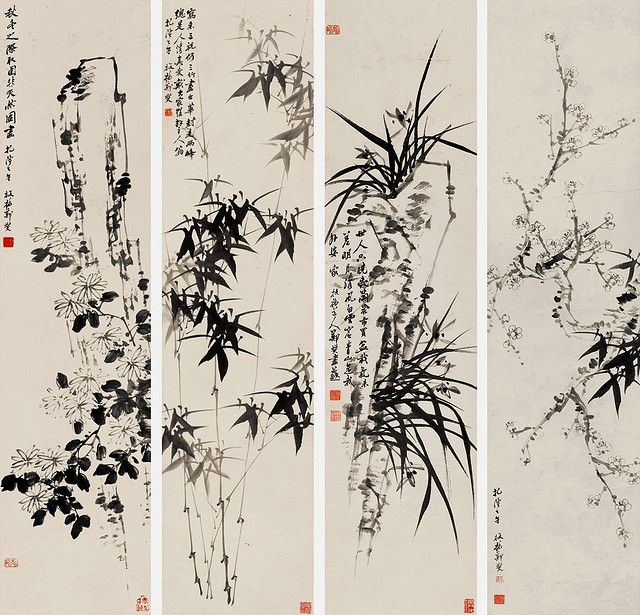
To paint bamboo well was to claim, implicitly, that you understood resilience. To paint it simply — without ornamentation, without showy technique — was to claim humility as well.
Zheng Banqiao became the most celebrated bamboo painter in the tradition, spending decades producing almost nothing else. He painted bamboo in moonlight, in rain, seen through a window at midnight. Each variation was less a new subject than a new angle on the same interior question. His style — sparse, gestural, the leaves carried on swift diagonal strokes — became the visual grammar that most people today recognise when they picture "Chinese ink bamboo."
This is the lineage that the Shadow of Bamboo travel tea set enters when its painters pick up a brush.
Bamboo's Three Virtues in Chinese Culture
- Hollow interior → Humility. Bamboo is empty at its core. In Confucian thought, the wise person is open to learning, never filled with self-importance.
- Segmented nodes → Discipline. Each joint marks a stage of growth, a pause and consolidation before the stalk extends further. Progress through structure.
- Bends without breaking → Resilience. The quality Zheng Banqiao spent a lifetime painting: yielding under pressure while remaining fundamentally unbroken.
The Object: What the Shadow of Bamboo Actually Is
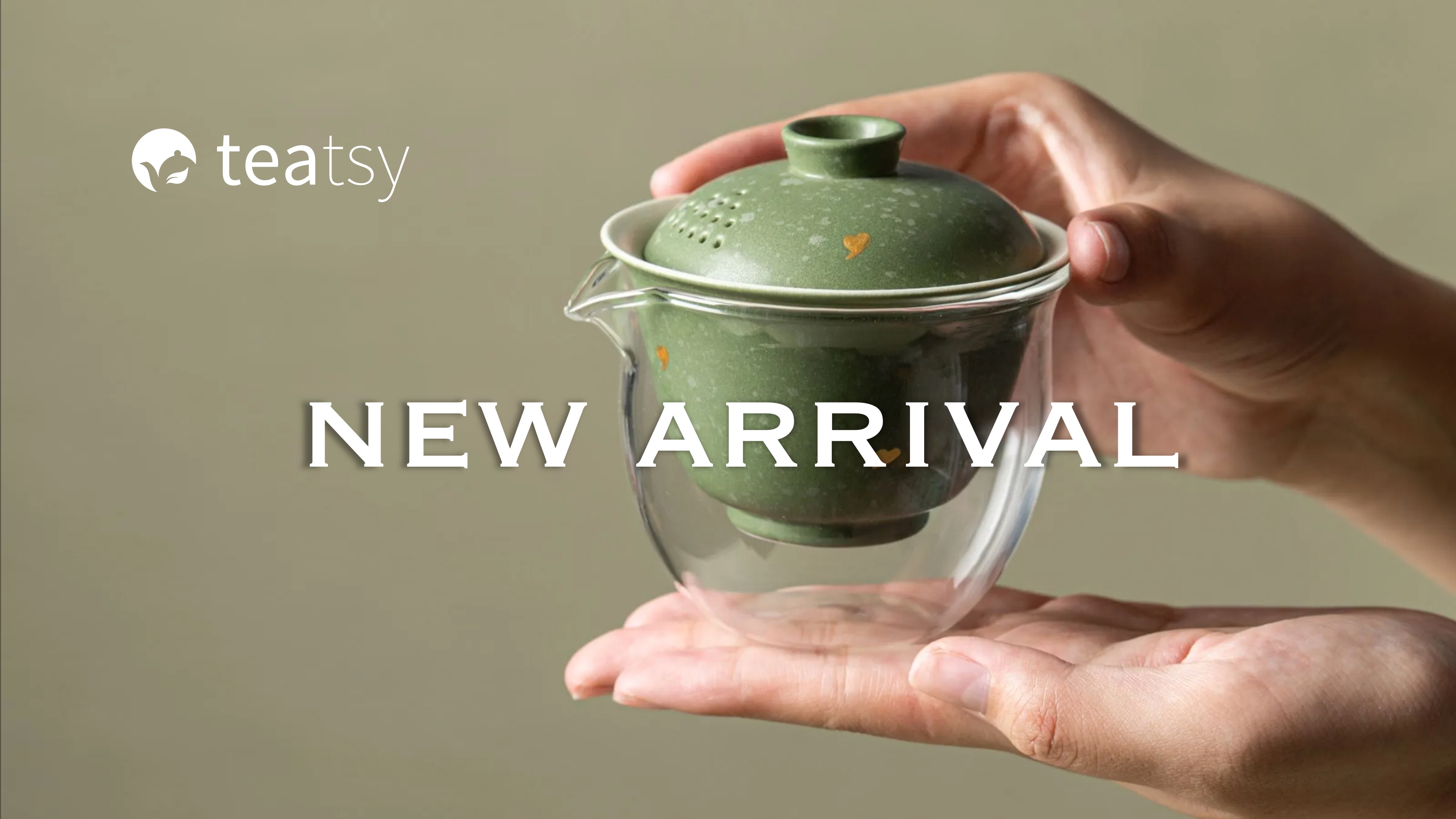
The Shadow of Bamboo Hand-Painted Lid Filter Travel Tea Set is a portable gongfu tea kit built around a ceramic gaiwan (盖碗) — the covered bowl that has sat at the heart of Chinese tea culture since the Ming dynasty. It pairs that gaiwan with three matching ceramic tasting vessels and a heavy-walled outer glass serving pitcher, all housed inside a slim commuter case made from dark leather-textured material. A kraft paper gift box and a paper tote bag are included for gifting.
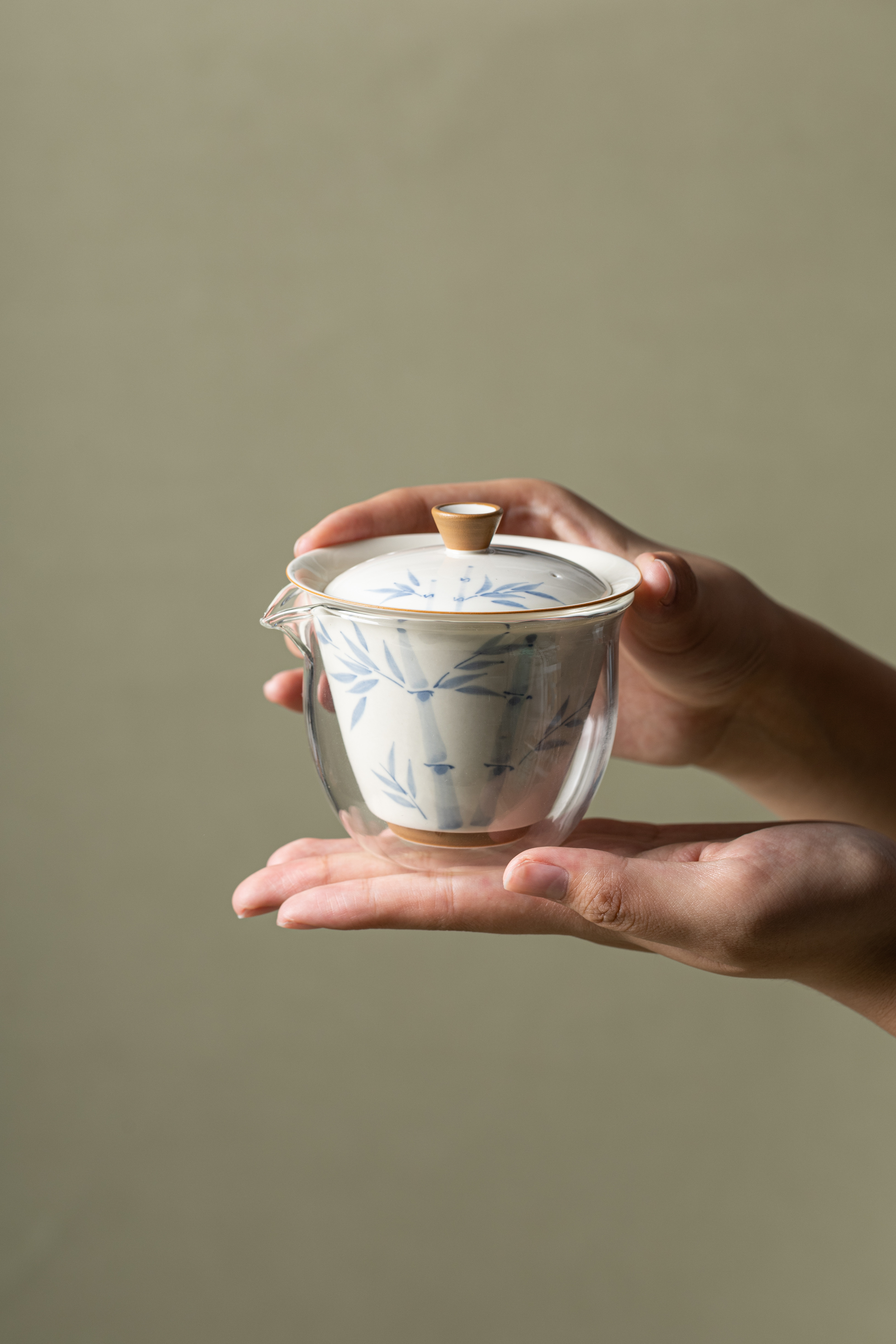 Straw ash glaze · hand-painted bamboo in light blue — every piece differs slightly due to the mineral content of kiln ash.
The Glaze: Straw Ash, Not Factory White
The body of each piece is fired with a straw ash glaze — a technique that produces a surface that is neither stark white nor uniform beige, but something in between: softly warm, with an organic variation from piece to piece that no two firings exactly repeat. The mineral content of the ash shifts across a kiln load, which means every set carries a slightly different ground colour. Against this quiet, textured surface, the bamboo stalks are painted in a pale, cool blue — the contrast between warm clay and cool pigment is precisely the tension that makes the image settle into the eye.
The Gaiwan: Built-in Filter, No Strainer Required
The gaiwan in this set incorporates a perimeter filter directly into the lid — a practical modification of the traditional form that eliminates the need for a separate strainer. A traditional gaiwan pour requires tilting the lid at just enough of an angle to hold back the leaves through a narrow gap, a technique that takes practice. The lid-filter makes this automatic, so the ritual remains intact without the learning curve demanding your attention mid-pour.
Why Carry a Tea Practice at All?
The question behind travel tea sets is not really about logistics — it is about whether a practice survives being moved. Most rituals don't. They depend on a specific kitchen, a specific chair, a specific silence. Take them out of that context and they dissolve into habit, then into nothing.
The bamboo analogy is useful here too. The whole point of the plant, in Chinese symbolism, is that it does not need calm conditions to maintain itself. It bends. The tea practice in this set is designed to do something similar: the ritual is compressed but not compromised. The same water temperature, the same sequence of rinse-and-steep, the same small cups — in a hotel room, in a park, at a desk in an unfamiliar city.
"True presence shouldn't be left behind when you step out the door," as the product description puts it. The Shadow of Bamboo is built for the person who finds that statement true.
What's in the Set
- Ceramic Gaiwan with built-in lid filter — hand-painted bamboo motif, straw ash glaze. Brews directly into the glass server.
- Heavy-walled outer glass server (pitcher) — collects the brewed tea for distribution into tasting cups without temperature loss.
- Three ceramic tasting cups — matching glaze and bamboo motif, sized for gongfu-style sipping.
- Slim travel case — dark leather-textured exterior with zipper closure, fits all pieces securely.
- Eco-friendly kraft paper gift box + paper tote bag — ready to give.
For the Commuter, the Traveller, the Person Who Doesn't Want to Choose Between Their Practice and Their Schedule
The Shadow of Bamboo is available worldwide through TeaTsy, with shipping to Singapore, Malaysia, Hong Kong, the United States, the United Kingdom, Australia, and beyond. It is a considered gift for someone who already drinks good tea — or for yourself, as the object that finally closes the gap between "I'd like to bring my tea practice with me" and actually doing so.
TeaTsy — Gongfu Travel Collection
Shadow of Bamboo Hand-Painted Lid Filter Travel Tea Set
A complete gongfu travel set built around a straw ash glaze gaiwan — hand-painted bamboo on every piece, brews directly into the glass server.