
Why It's 工夫 and Not 功夫: The Word Behind Gongfu Tea
Sep 01,2026 | TeaTsy Team
Reading time: 7 minutes
If you've encountered gongfu tea in the West, you've probably seen it written as "kung fu tea" — and immediately pictured someone performing martial arts with a teapot.
It's an understandable confusion. But it rests on a mistranslation that hides something worth knowing. Because in Chinese, two different characters are pronounced almost identically — and tea uses the one most Westerners have never seen.
Two words, one sound
功夫 (gōngfū) is the one you know. It appears on movie posters and dojo walls. It means skill, mastery, ability earned through discipline. When Bruce Lee spoke of kung fu, this is the character he meant.
工夫 (gōngfū) is different. The first character, 工, means labour, work, craft — it's a pictograph of a carpenter's tool. Combined with 夫, the compound means something closer to the time and effort you willingly put into something.
Not skill you demonstrate. Effort you choose to spend.
Chinese scholars of tea culture — most notably Chen Xiangbai, whose work on Chaozhou tea customs remains a standard reference — have long argued that tea should be written with 工夫, not 功夫. The distinction isn't pedantry. The two characters point at genuinely different things, and only one of them describes what actually happens when you make tea this way.
(In practice, both spellings circulate widely in China, and 功夫茶 appears on plenty of shop signs. But the older written records, including the Qing dynasty accounts of Chaozhou tea drinking, use 工夫 — and the meaning fits better.)
The word tea farmers use
Here's the strongest evidence that 工夫 is the right character: it doesn't only describe how tea is brewed. It describes how tea is made.
Several of China's most celebrated black teas carry the word in their names:
- Tan Yang Gongfu (坦洋工夫), from Fujian
- Zheng He Gongfu (政和工夫), also Fujian
- Bai Lin Gongfu (白琳工夫), from the same region
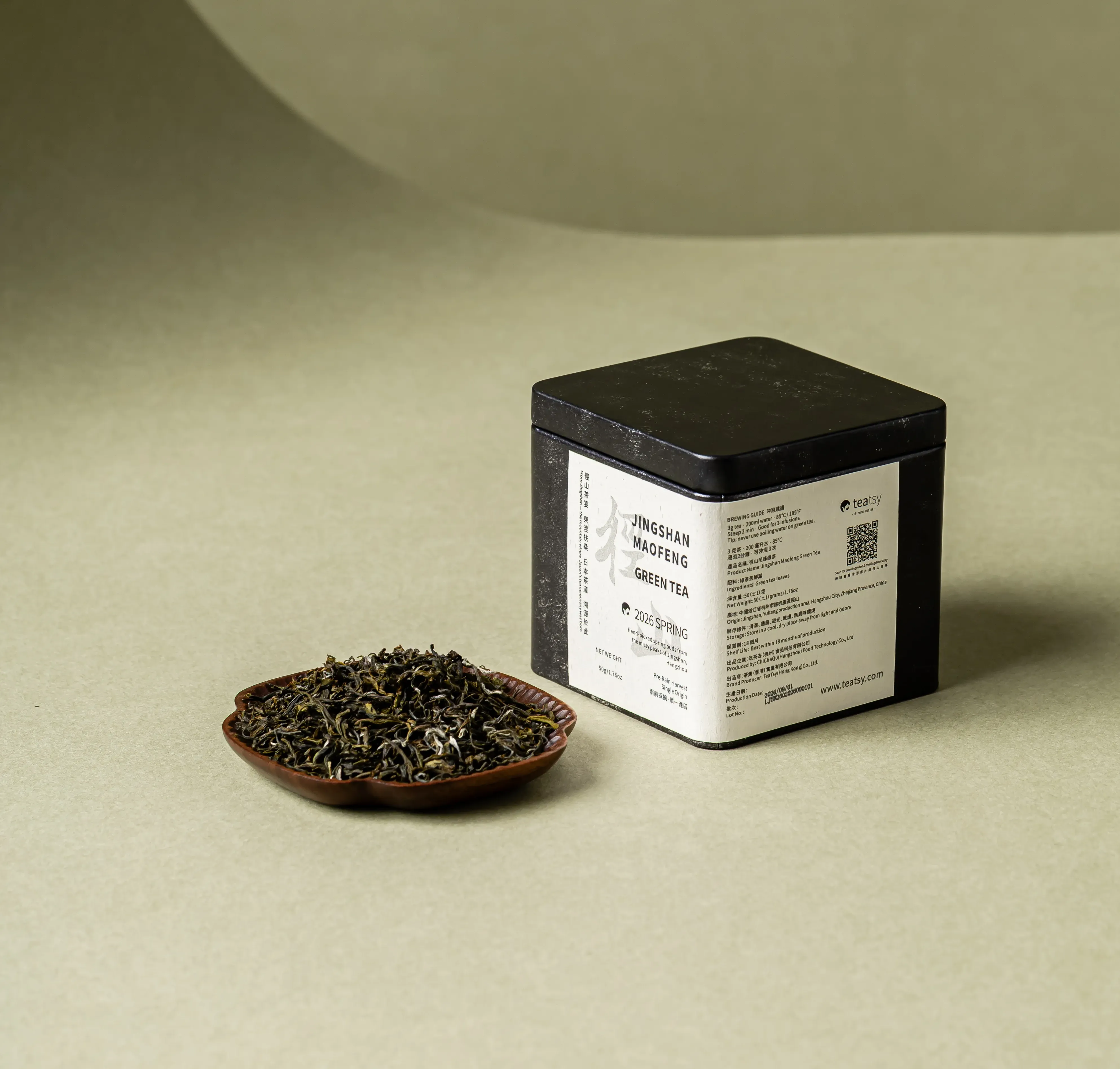
These are called gongfu teas not because they taste like martial arts, but because their production is exhaustingly labour-intensive. Withering, rolling, oxidising, sorting, drying — each step done with attention, each step capable of ruining the leaf if rushed.
The name is a description of the work. Nobody is showing off. Somebody simply decided the tea was worth that much trouble.
That's 工夫.
Chaozhou, three hundred years ago
Gongfu tea as a brewing method emerged in Chaozhou, in China's southern Guangdong province, sometime in the 18th century. The earliest written descriptions appear in Qing dynasty texts documenting local customs.
What's notable is how ordinary it was.
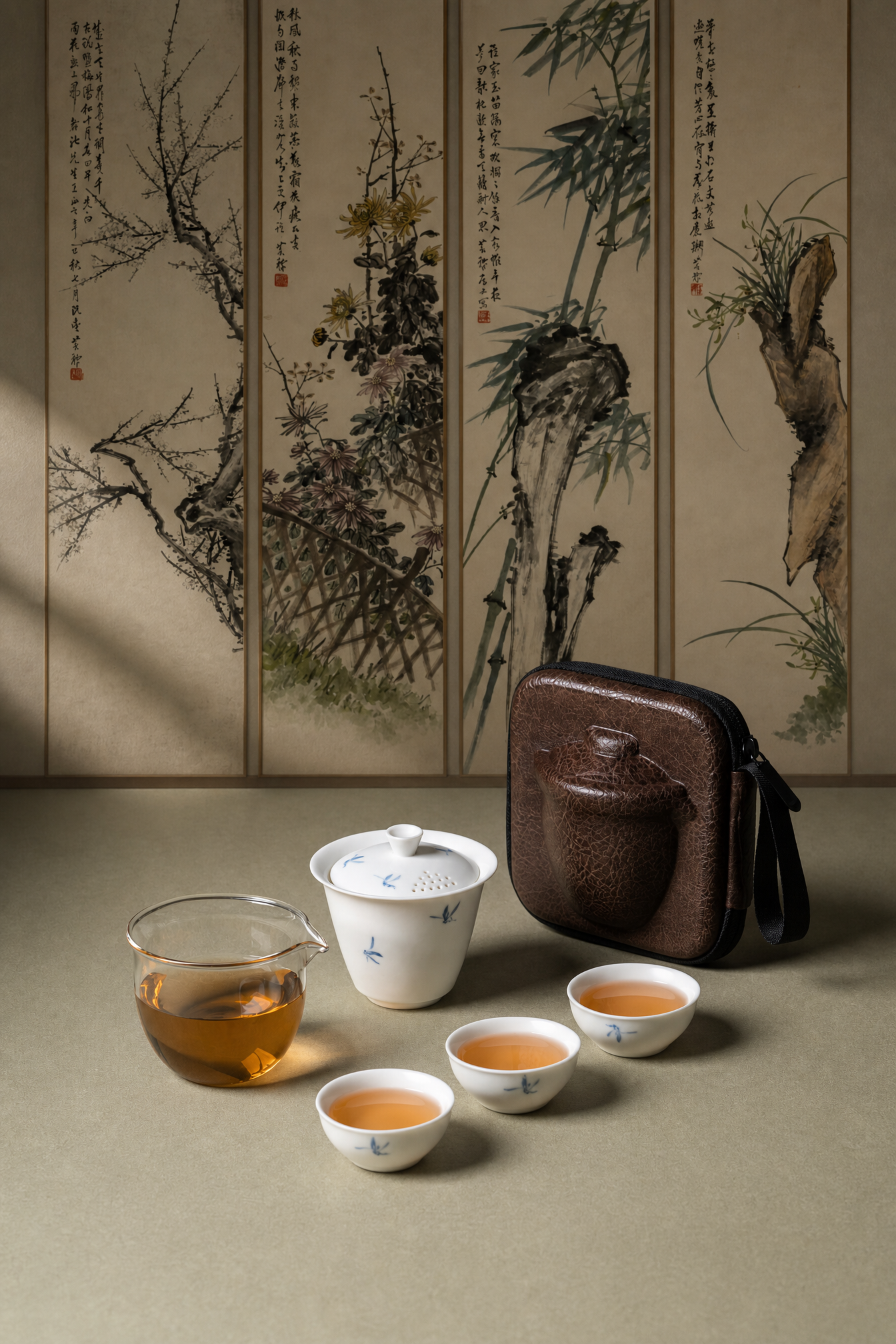
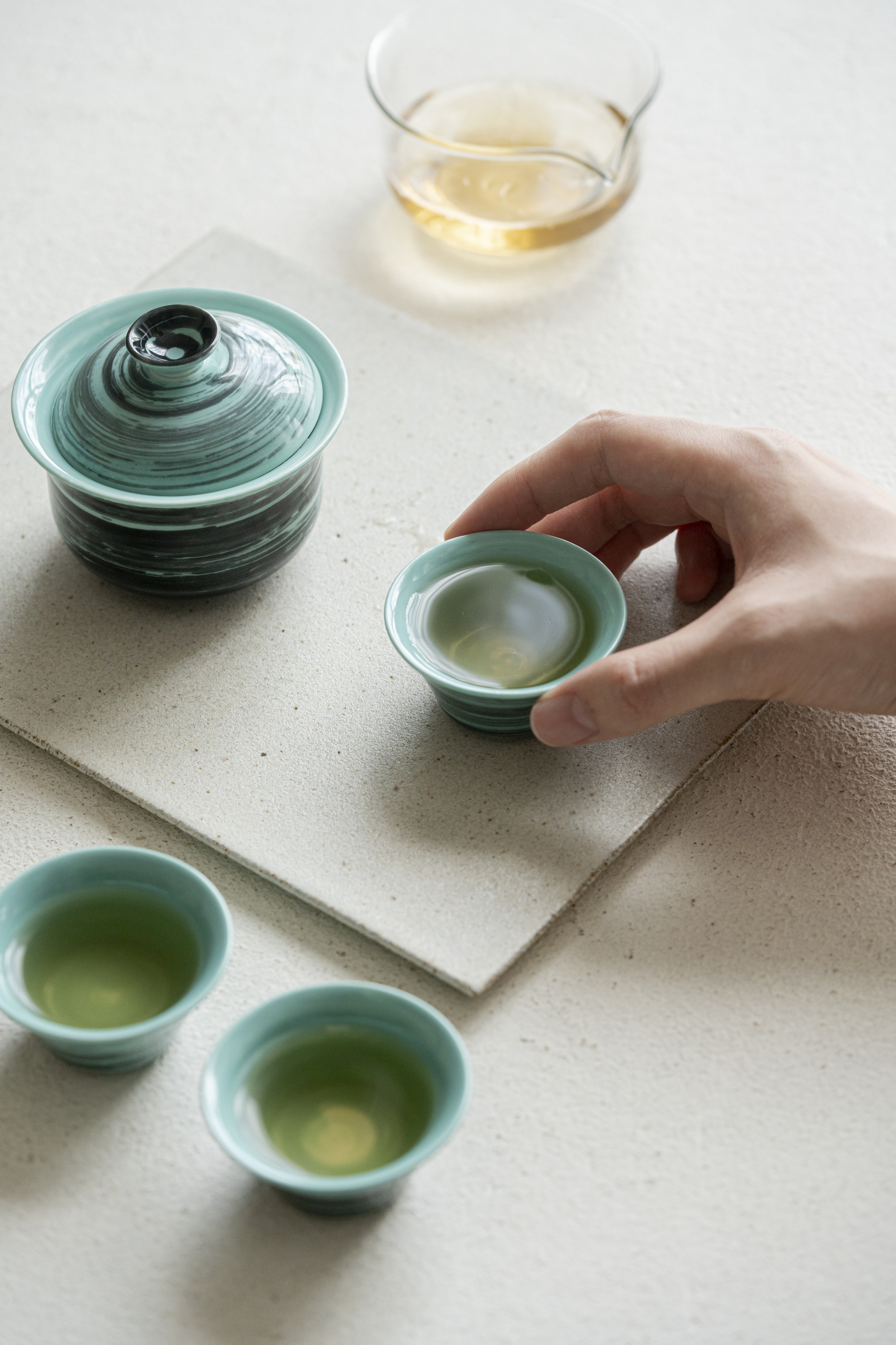
This was not an imperial ceremony or a monastic ritual. It was what people did in shops, in courtyards, at the back of family businesses. A small clay pot. Cups the size of a walnut. Leaves packed dense, water poured fast, tea decanted in seconds — then repeated, again and again, each steep slightly different from the last.
The cups were small so the tea could be drunk hot and shared often. The pot was small so the leaves could be steeped many times. Every element of the method existed for a practical reason, and the practical reasons happened to produce something beautiful.
It was never a performance. It was a way of sitting with people and taking your time.
Why the method survives
Gongfu brewing produces a genuinely different result from Western steeping, and the difference is measurable rather than mystical.
A Western tea bag holds about 2 grams of leaf, steeped in 250ml of water for three to five minutes. One extraction, one cup, one flavour profile — and by the end of it, the leaf has given everything at once, including the bitter compounds that emerge late.
Gongfu brewing inverts the ratio: roughly 5 grams of leaf in 100ml of water, steeped for 10 to 30 seconds, then poured off completely. The high leaf-to-water ratio extracts intensely; the short contact time stops before bitterness develops.
And then you do it again. And again. A good oolong will yield six or seven distinct infusions — the first bright and aromatic, the middle steeps deepening into fruit and honey, the last ones soft and mineral. You're not drinking the same tea repeatedly. You're following it through a sequence.
This is why gongfu tea rewards attention. The tea changes, so you have to be present to notice.
The limitation nobody questioned
For three centuries, gongfu tea required a place.
A table. A tray to catch the water. A kettle at the boil. A gaiwan or pot, a pitcher, a set of cups. The method assumed you were at home, or in a teahouse, or behind a shop counter with time to spare.
Which meant that the moment you left — for the office, for a train, for anywhere — you left the tea behind. What travelled with you was a tea bag, or nothing at all.
For most of history this was simply accepted as the nature of the thing. Proper tea belonged to proper settings.
We didn't think that was necessary.
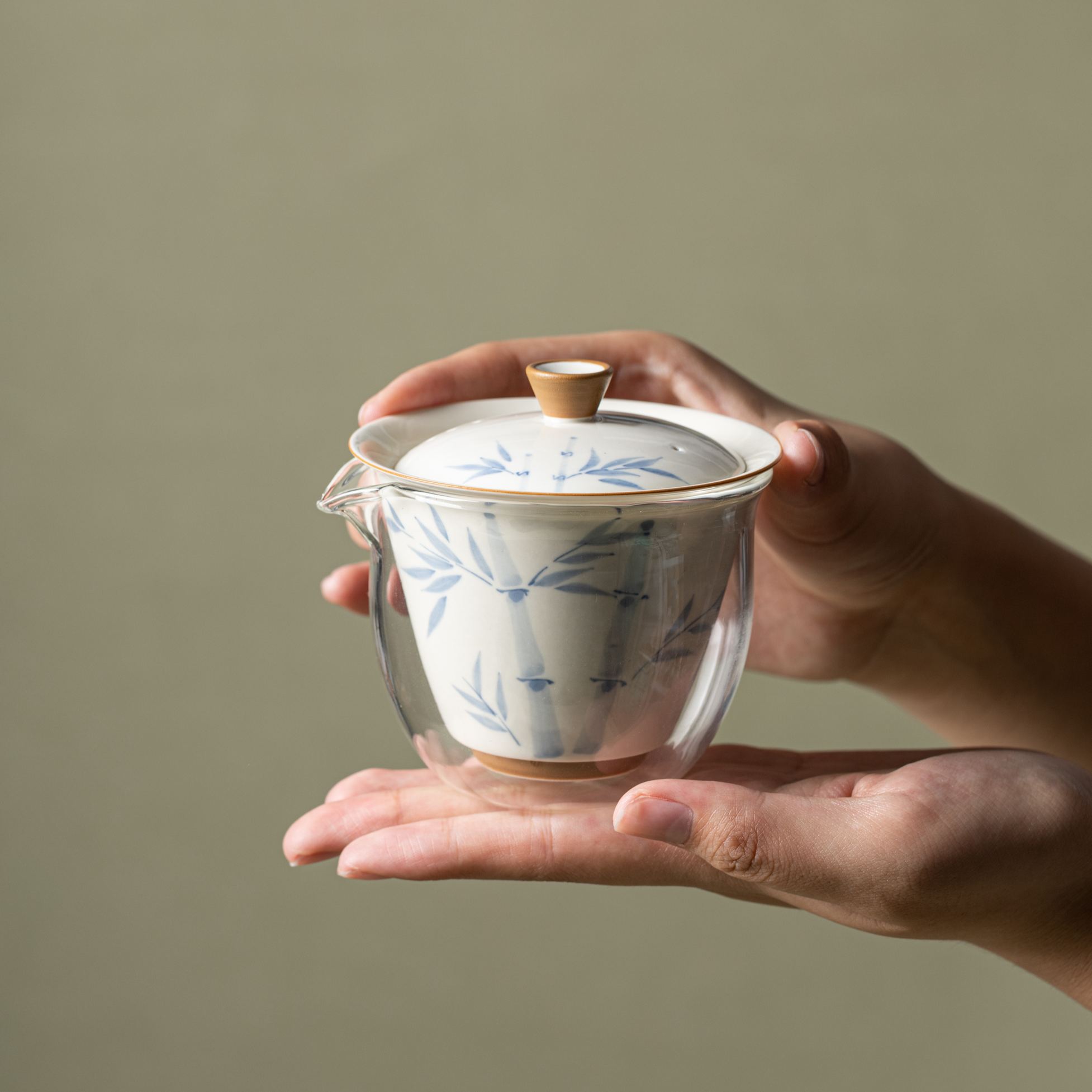
Gongfu brewing depends on three mechanical conditions: a high leaf-to-water ratio, precise control of steeping time, and complete separation of leaf from liquid at the moment you decide. None of those conditions require a table. They require a vessel that can hold leaves, control flow, and separate cleanly — reliably, in one hand, without a tray to catch the mess.

That's the problem our rotating strainer was built to solve. The strainer turns to open and close the flow, which means you can stop the steep at the second you want it stopped, pour off completely, and start again — on a desk between meetings, on a train, at a campsite. Same principle as a Chaozhou tea table. Fewer requirements.
The tradition didn't need to be modernised. It needed to be portable.
What it asks of you
There's a version of tea culture, popular in wellness marketing, that presents gongfu brewing as an elaborate ritual requiring years of study and a room full of implements. This is mostly invention, and it does the tradition a disservice.
Here is what gongfu tea actually requires:
Leaves worth the trouble. Loose leaf, whole, from somewhere specific. This matters more than any equipment.
A vessel you can pour off completely. A gaiwan, a small pot, anything with a proper strainer. The critical function is stopping the steep on time.
Attention for about three minutes. Not meditation. Not mindfulness practice. Just noticing what you're doing while you do it.
That's the entire method. There is no belt to earn, no sequence to memorise, no correct way to hold your wrist.
工夫 doesn't mean you've mastered something. It means you decided something was worth doing properly.
The distinction, one more time
功夫 is skill you can display.
工夫 is time you willingly give.
Tea takes the second character, and it always has. Not because tea is easy — good tea is difficult in a dozen ways — but because the difficulty is never the point. The point is that somebody, somewhere along the line, decided this leaf deserved care. The farmer who withered it slowly. The roaster who watched the temperature. And now you, standing over a cup, waiting the extra twenty seconds because the tea will be better for it.
That's the whole tradition. It's not a discipline. It's a decision, repeated.
Three minutes of your attention, given freely.
That's all it ever meant.
TeaTsy designs portable tea ware for people who want proper tea wherever they are. Our rotating strainer was developed so that gongfu brewing — precise ratios, controlled timing, clean separation — could happen without a tea table. Explore the collection.
發表評論