
A Love Story in Every Turn: From the Romance of the Western Chamber to Your Tea Cup
Nov 10,2026 | TeaTsy Team
Introduction: A Story That Keeps Turning
Long before stories were told on screens, they lived in books, paintings, theatre, and even porcelain. Some were remembered for their heroes, others for their tragedies. And some endured because they spoke of something remarkably simple: the desire to love freely.
Among China's most celebrated literary romances is Romance of the Western Chamber / 西廂記 (Xixiang Ji), a story of two young lovers, a clever matchmaker, and the courage to follow the heart despite the expectations of society.
Written for the stage more than seven centuries ago, the story would eventually find new life in illustrated books, paintings, and blue-and-white porcelain. Today, it offers another way to be experienced: through the gentle rotation of a tea cup.
The Romance of the Western Chamber: A Love Beyond Convention
Written by the Yuan-dynasty playwright Wang Shifu (王實甫), Romance of the Western Chamber / 西廂記 tells the story of Zhang Sheng, a young scholar, and Cui Yingying, the daughter of a distinguished family.
Their paths cross at Pujiu Temple, where Yingying is staying with her mother. Zhang is immediately captivated by her, and a mutual affection gradually develops through poetry, music, and fleeting encounters.
Yet their relationship is far from straightforward. In a society where marriage was shaped by family authority and social standing, personal affection alone was not enough to determine their future.

Portrait of Cui Yingying. From Min Qiji's color woodblock prints of Romance of the Western Chamber / 西廂記, 1640. Historical collection: Museum of East Asian Art, Cologne.
This delicate portrait of Cui Yingying comes from a remarkable series of woodblock prints produced in 1640 under the direction of the Ming-dynasty publisher Min Qiji.
With her graceful posture, lowered gaze, and finely outlined robes, Yingying appears both composed and introspective. Rather than depicting a dramatic moment, the image introduces the woman at the heart of the story, inviting the viewer to imagine the emotions beneath her quiet expression.
A Promise Broken: Love Meets Family Expectations
One of the drama's defining conflicts begins when Pujiu Temple is threatened by an armed force. Yingying's mother promises her daughter's hand in marriage to whoever can resolve the danger.
Zhang Sheng helps secure assistance from a military commander, and the temple is saved. But when the time comes to honor her promise, Yingying's mother refuses to approve their marriage, regarding Zhang's social position as unsuitable.
For the young lovers, what appeared to be a path toward happiness becomes another obstacle.

Scene Seven: The Broken Marriage Promise (夫人停婚). From Min Qiji's 1640 Romance of the Western Chamber / 西廂記 print series.
The seventh illustration in Min Qiji's series depicts this moment of disappointment. The figures gather around a formal setting, their restrained gestures suggesting the tension between family authority and personal feeling.
The composition is notably spare. Rather than filling the page with elaborate scenery, the artist allows the arrangement of the figures, furniture, and decorative carpet to carry the narrative.
It is a scene that captures one of the central questions of the play: should love be determined by social convention, or by the people who experience it?
Their story continues with the help of Hongniang (紅娘), Yingying's resourceful maid. Acting as a messenger and confidante, she helps the young lovers remain connected despite the restrictions placed upon them. Over time, Hongniang became such a beloved figure in Chinese culture that her name came to be associated with matchmaking itself.
When Music Speaks: Yingying Listens to the Qin
Not every important moment in Romance of the Western Chamber / 西廂記 unfolds through spoken dialogue.
In one of its most memorable episodes, Zhang Sheng expresses his feelings through the guqin, a traditional Chinese plucked-string instrument long associated with scholars, poetry, and cultivated expression.
Yingying listens, moved by the music. What cannot be openly declared finds its way through melody.
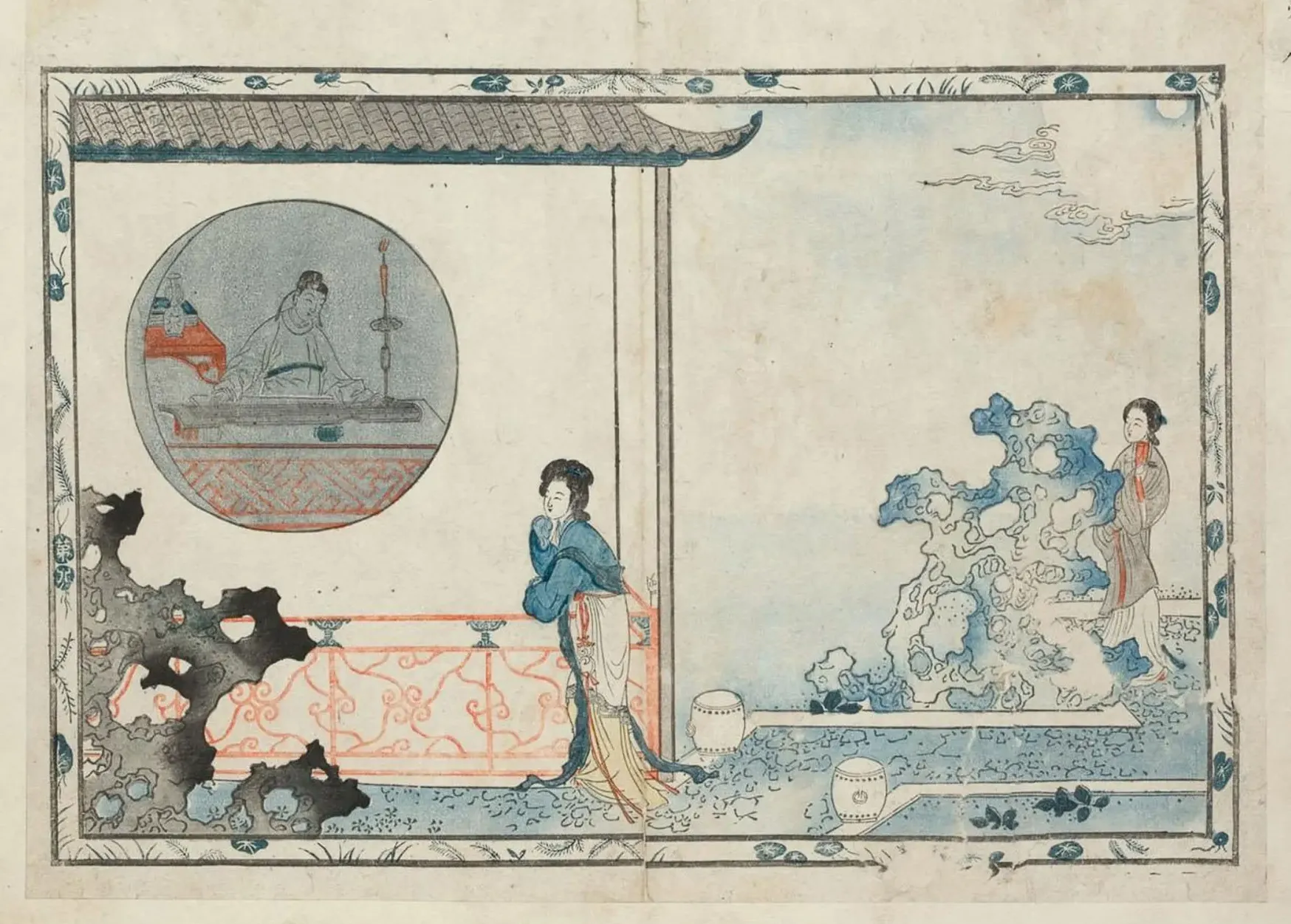
Scene Eight: Yingying Listens to the Qin (鶯鶯聽琴). Min Qiji, 1640. Museum of East Asian Art, Cologne.
In this illustration, Zhang sits with his instrument inside a circular window, while Yingying listens from the courtyard. Architectural lines divide the composition into separate spaces, yet the implied sound of the music connects them.
The pale blue garden rocks, decorative border, and carefully placed figures create an atmosphere of distance and intimacy at the same time.
The scene is especially compelling because it suggests so much without depicting a direct encounter. Two people remain apart, but their feelings are brought together through music.
From Theatre to Woodblock Prints: A Story Becomes Art
The influence of Romance of the Western Chamber / 西廂記 extended far beyond the theatre. Over the centuries, the play inspired illustrated editions, paintings, decorative objects, and scenes reproduced in a variety of artistic media.
Among its most extraordinary visual interpretations is the series published by Min Qiji (閔齊伋) in 1640, near the end of the Ming dynasty.
The complete series contains twenty-one images: an introductory portrait of Cui Yingying, followed by twenty illustrations inspired by episodes in the drama. It is celebrated for its inventive compositions and sophisticated use of multicolor woodblock printing.
The three historical images featured above belong to this remarkable tradition. They reveal how artists transformed theatre into a visual experience, finding ways to communicate emotion through gesture, setting, space, and color.
Each picture captures a moment from a larger narrative. Together, they allow the viewer to revisit the story in fragments, discovering new details with every look.
When Stories Were Painted on Porcelain
The same desire to preserve and share familiar stories also found expression in Chinese ceramics.
Narrative scenes from Romance of the Western Chamber / 西廂記 appeared on porcelain during the late Ming dynasty and became particularly popular during the Kangxi period of the Qing dynasty.
Artists working in blue-and-white porcelain translated theatrical scenes into compositions shaped by the curves of vases, jars, and other ceramic vessels. Architecture, landscapes, and human figures were arranged to give each surface a story of its own.
A surviving example is a Kangxi-period blue-and-white porcelain vase in the collection of The Metropolitan Museum of Art, New York. Its painted scenes demonstrate how a literary romance could become part of an everyday decorative object.

Blue-and-white porcelain vase with scenes from Romance of the Western Chamber / 西廂記. Qing dynasty, Kangxi period. The Metropolitan Museum of Art, New York, 79.2.412. Public Domain.
These objects demonstrate an enduring feature of Chinese decorative arts: a vessel could be more than a useful or beautiful object. It could also become a place where literature, memory, and artistic imagination meet.
A Story That Moves: The West Chamber Tea Cup
At TeaTsy, we wanted to bring this tradition of storytelling through porcelain into a form that could be enjoyed during an ordinary tea session.
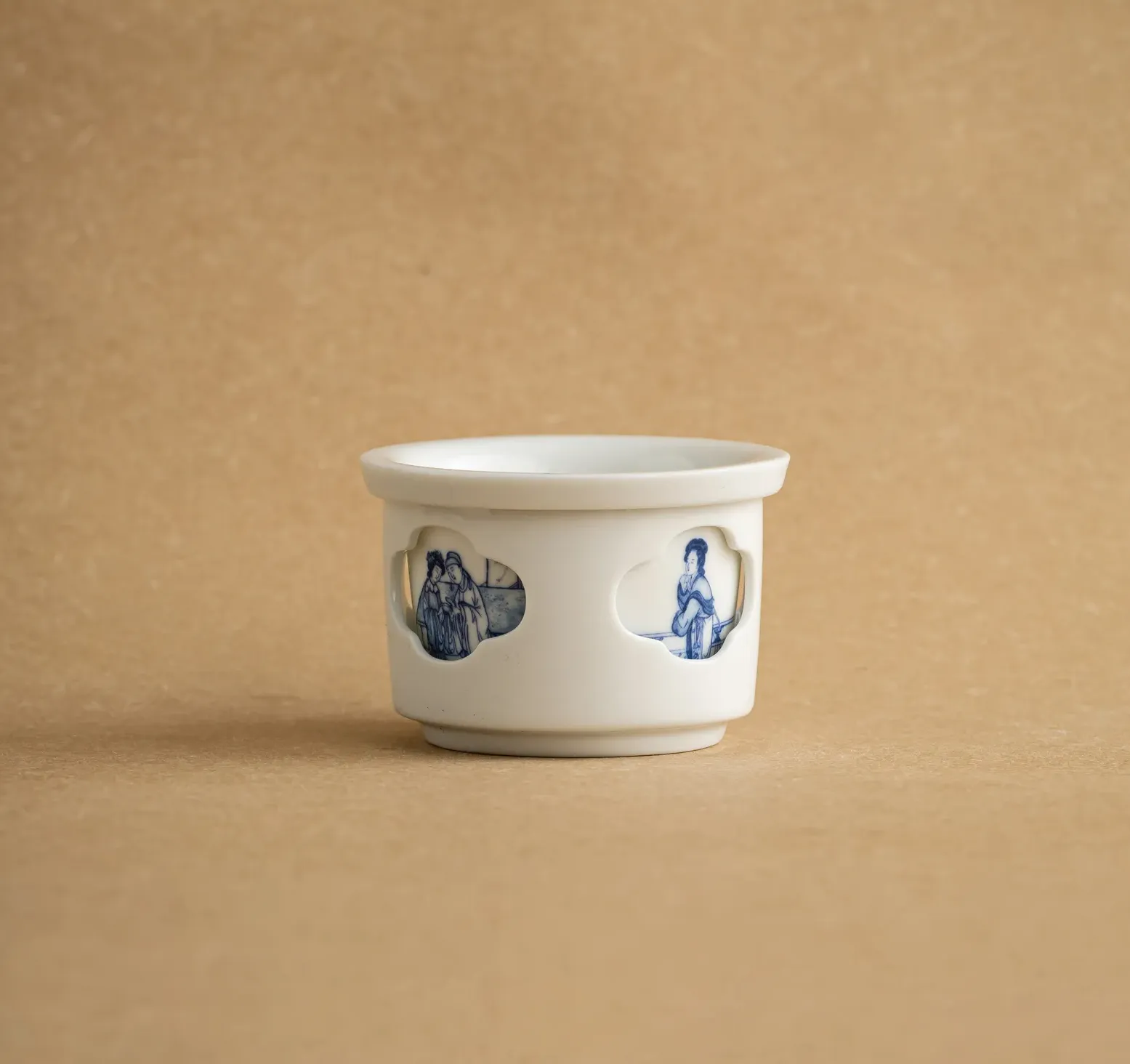
Inspired by Romance of the Western Chamber / 西廂記, our West Chamber / 西廂記 Rotating Story Tea Cup brings together classical blue-and-white imagery and a gently moving porcelain structure.
Its double-layer design features a stationary outer wall with shaped viewing windows. Within it, an illustrated inner porcelain cup can rotate independently, gradually revealing four different compositions.
Instead of presenting every image at once, the design invites the viewer to turn the cup, pause, and discover the changing details.
There is something fitting about this movement. Just as a story unfolds through a sequence of scenes, the imagery on the tea cup changes with each gentle turn.
The historical prints introduced earlier reveal how artists once interpreted the drama through carefully arranged pictures. The rotating cup offers a contemporary way to explore that same tradition of storytelling in porcelain.

One More Turn. One More Cup.
In traditional Gongfu tea preparation, tea is often served in small portions across several infusions. Each cup encourages a brief pause to notice the aroma, flavor, and gradual changes in the leaves.
With a capacity of 75 ml, the West Chamber / 西廂記 cup is designed for this unhurried approach to drinking tea.
Between infusions, a gentle turn of the inner porcelain cup reveals another illustrated detail. A figure appears in a window. A different composition comes into view. The familiar act of drinking tea becomes a small moment of discovery.
Not every story needs to be read from beginning to end in a single sitting. Some invite us to return, look again, and notice something we missed before.
Keeping an Old Story Close
Romance of the Western Chamber / 西廂記 has traveled across centuries and artistic forms, from Yuan-dynasty theatre to Ming-dynasty woodblock prints, Qing-dynasty porcelain, and beyond.
Its lasting appeal lies not only in the romance between Zhang Sheng and Cui Yingying, but in the emotions that continue to feel familiar: anticipation, uncertainty, longing, and the hope of being together.
For TeaTsy, bringing this story into a contemporary tea cup is a way of keeping Chinese art and literature present in everyday life. A centuries-old tale does not have to remain behind museum glass or between the pages of a book. Sometimes, it can find a quiet place on the tea table.
Frequently Asked Questions
What is Romance of the Western Chamber?
Romance of the Western Chamber / 西廂記 is a celebrated Chinese romantic drama written by Wang Shifu during the Yuan dynasty. It tells the story of Zhang Sheng and Cui Yingying, two young lovers who face social and family obstacles before ultimately being reunited.
Why does Romance of the Western Chamber appear on Chinese porcelain?
The play became an important subject in Chinese visual culture. Its recognizable characters and dramatic episodes inspired illustrations, paintings, and decorative porcelain, particularly during the late Ming and Qing dynasties.
Who created the historical illustrations featured in this article?
The three woodblock illustrations come from a series published by Min Qiji in 1640. The series contains a portrait of Cui Yingying and twenty narrative illustrations. A historical copy is preserved at the Museum of East Asian Art in Cologne, Germany.
How does the West Chamber tea cup rotate?
The TeaTsy West Chamber / 西廂記 cup has two permanently assembled porcelain layers. A miniature bearing at the base supports the independently rotating inner cup, while the outer porcelain wall stays still. As the inner layer turns, different blue-and-white illustrations appear through the outer viewing windows.
Can the inner and outer porcelain layers be separated?
No. The layers are permanently assembled and should not be taken apart. Turn the inner cup gently, wash it by hand, and avoid dishwashers, microwaves, and prolonged soaking.
Historical References & Image Credits
Min Qiji, Romance of the Western Chamber / 西廂記 woodblock print series, 1640. Collection: Museum of East Asian Art, Cologne. Digitized image references: Shuge.
Historical porcelain reference: The Metropolitan Museum of Art, New York, accession 79.2.412.
發表評論