
The City That Built the World's China
Nestled in the forested mountains of northeastern Jiangxi Province, Jingdezhen (景德鎮) has been producing ceramic ware for more than 1,700 years. By the Song Dynasty (960–1279 CE), its kilns were already supplying the imperial court. In 1004 CE, Emperor Zhenzong granted the city his reign-era name — Jingde — and ordered every piece of imperial porcelain to bear the inscription "Made in Jingde" on its base. A tradition, and a city's identity, were sealed.

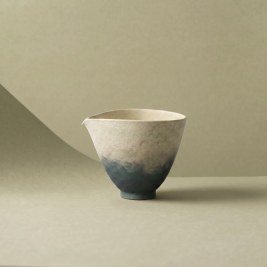
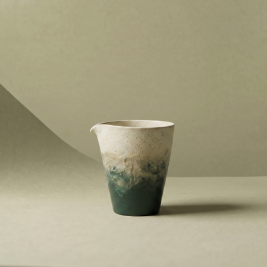
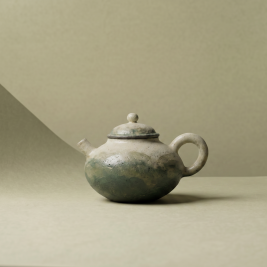
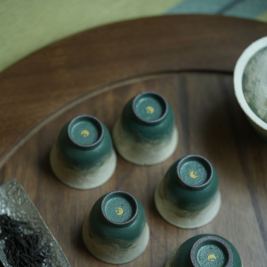
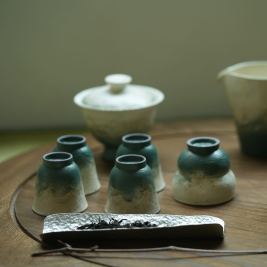
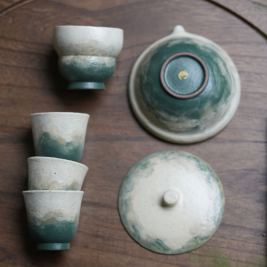
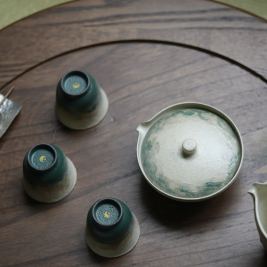
The complete Lake Veil collection — each piece hand-thrown in Jingdezhen and fired above 1,330°C.
During the Ming and Qing dynasties, Jingdezhen reached the apex of its influence. The city's famous imperial kilns (御窑, Yù Yáo) produced the cobalt-blue-and-white porcelain that sailed aboard Dutch East India Company ships to Europe, where it ignited a mania collectors called chinoiserie. Kings paid fortunes for it. Potters spent lifetimes replicating it. No city on earth has shaped the Western dining table — or the Eastern tea ceremony — quite like Jingdezhen.
"Jingdezhen: where a thousand kilns glow at night, and a hundred boats carry porcelain by dawn."
— Tang-era verse describing the city at its peak
Today, Jingdezhen's 1.6 million residents still live and breathe ceramics. The city is home to hundreds of independent studios, the legendary Ceramic University of China, and a new generation of artisans who fuse ancient kiln techniques with contemporary design sensibilities. It remains, without question, the Porcelain Capital of the World.
Why Jingdezhen? The Secret Beneath the Mountains
Great ceramics begin with exceptional raw materials, and Jingdezhen sits atop one of the most remarkable geological formations on earth. The surrounding Gaoling (高嶺) hills are rich in kaolin — the pure white clay that gives porcelain its name in almost every European language (from Portuguese pó de Gaoling, "powder of Gaoling"). Kaolin fires to a translucent, glass-like density that common earthenware cannot achieve.

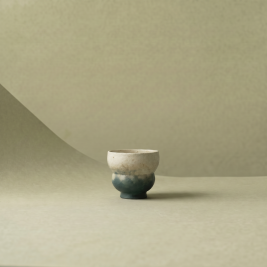
For the kiln-change stoneware in the Lake Veil series, artisans blend local kaolin with iron-rich secondary clays. This combination creates a body that holds heat evenly, rings true when tapped, and develops a subtly textured surface — the ideal canvas for a reactive glaze that transforms unpredictably in the fire.
The Art of Hand-Throwing: Where Muscle Memory Meets Meditation
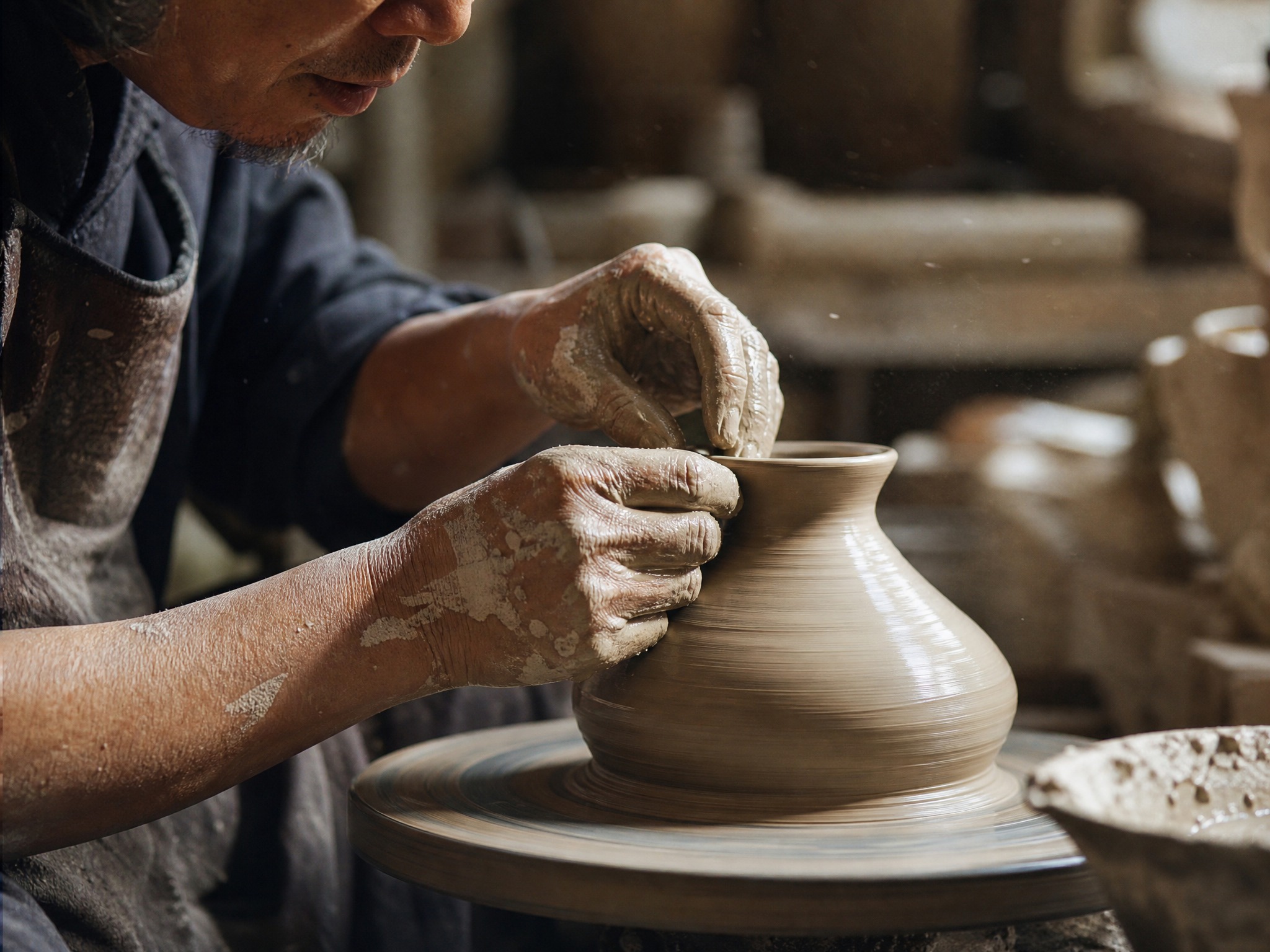
Walk through Jingdezhen's ceramic district today and you will hear, before you see, the workshops: the rhythmic slap of clay on a wheel, the low hum of the kick-wheel's flywheel, the soft scrape of a bamboo rib shaping a wall. Hand-throwing (拉坯, Lā Pēi) is the foundational skill of Jingdezhen craftsmanship, and it takes a master potter a decade of daily practice to execute it consistently.
Unlike industrial casting — where liquid slip is poured into plaster moulds and every piece is identical — hand-throwing is an act of negotiation between the potter's hands and the clay's own personality. The wheel spins; the potter centres the clay with cupped palms, opens the base with pressing thumbs, and draws the walls upward with fingertip pressure from within and without. A slight variation in speed, humidity, or hand pressure produces a unique contour. No two hand-thrown pieces share exactly the same wall thickness, rim profile, or foot ring.
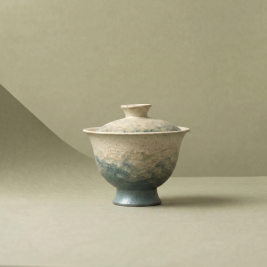
For pieces like a gaiwan or a straight-sided tea cup, the margin for error is measured in millimetres. Too thick, and the piece feels clunky and retains too much heat. Too thin, and it cracks during high-temperature firing. Experienced Jingdezhen throwers calibrate this by touch alone, eyes half-closed, reading the clay through their palms.
Kiln Change (窯變): The Magic That Cannot Be Commanded
Of all Jingdezhen's many glaze traditions, none is more revered — or more mysterious — than kiln change (窯變, Yáo Biàn). The concept is ancient: a glaze enters the kiln one colour and emerges as something entirely different, transformed by the chemistry of heat, flame, and atmosphere in ways no potter can fully predict or control.
The legendary Jun Kiln of the Song Dynasty first perfected this art, creating vessels with blue-purple glazes that shimmered like northern skies. Song court poets celebrated the effect with the phrase "一色入窑,万彩出窑" — "one colour into the kiln, ten thousand colours out."
The Science Behind the Magic
Modern ceramic science has partly decoded kiln change, though it has not diminished its wonder. The reactive glazes used on the Lake Veil series contain iron oxide and copper compounds suspended in a silica matrix. During firing above 1,330°C, several reactions happen simultaneously:
- Copper reduction: When the kiln atmosphere is oxygen-poor, copper oxide converts to cuprous oxide, producing greens and turquoises. When oxygen-rich pockets develop, it shifts toward red. Both can appear on the same piece.
- Iron migration: Iron compounds in the glaze are mobile at high temperatures and flow downward under gravity, creating streaks and gradients.
- Silica devitrification: Tiny crystals nucleate within the glaze as it cools, producing the star-speckled "oilspot" texture that shifts colour in different light.
- Clay-glaze interaction: Where the glaze thins at the rim and foot, the clay body's minerals bleed through, creating halos and natural edges.
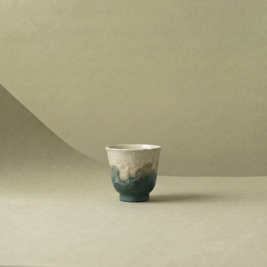
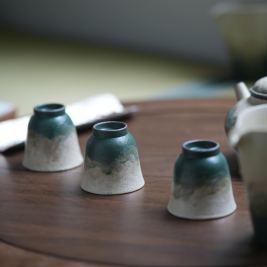
The combined result — a dreamy blue-green gradient that fades into warm earth at the base, dotted with iridescent specks — is entirely unique on every piece. No two Lake Veil cups will ever look the same. This is not marketing language. It is kiln physics.
From Mountain Clay to Your Tea Table: 12 Handcrafted Steps
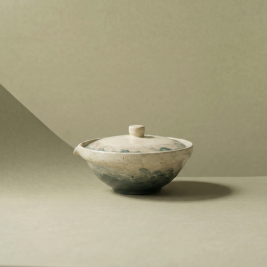
Each piece in the Lake Veil series passes through more than a dozen distinct handwork stages before it reaches you. Mechanised production skips most of these; Jingdezhen master-craft skips none.
Clay selection & blending — Local kaolin is mixed with iron-bearing secondary clays and aged for weeks to improve plasticity.
Wedging — The clay mass is kneaded by hand to eliminate air pockets that would cause the piece to explode in the kiln.
Centring — The clay is thrown onto a spinning wheel and centred with cupped palms — the most skill-intensive step.
Opening & throwing — The walls are drawn upward and shaped into the specific silhouette of each vessel form.
Rim finishing — The rim is hand-pinched to create the organic, subtly octagonal texture unique to this series.
Wire cutting & drying — The piece is cut from the bat and dried slowly for 1–3 days to prevent warping.
Trimming (foot ring) — The leather-hard piece is returned to the wheel and the base is trimmed to a precise foot ring.
Bisque firing — A first firing at ~900°C solidifies the clay body without vitrifying it, making it ready for glaze.
Glaze preparation — The reactive glaze is mixed in precise ratios; small batch variations affect the final colour outcome.
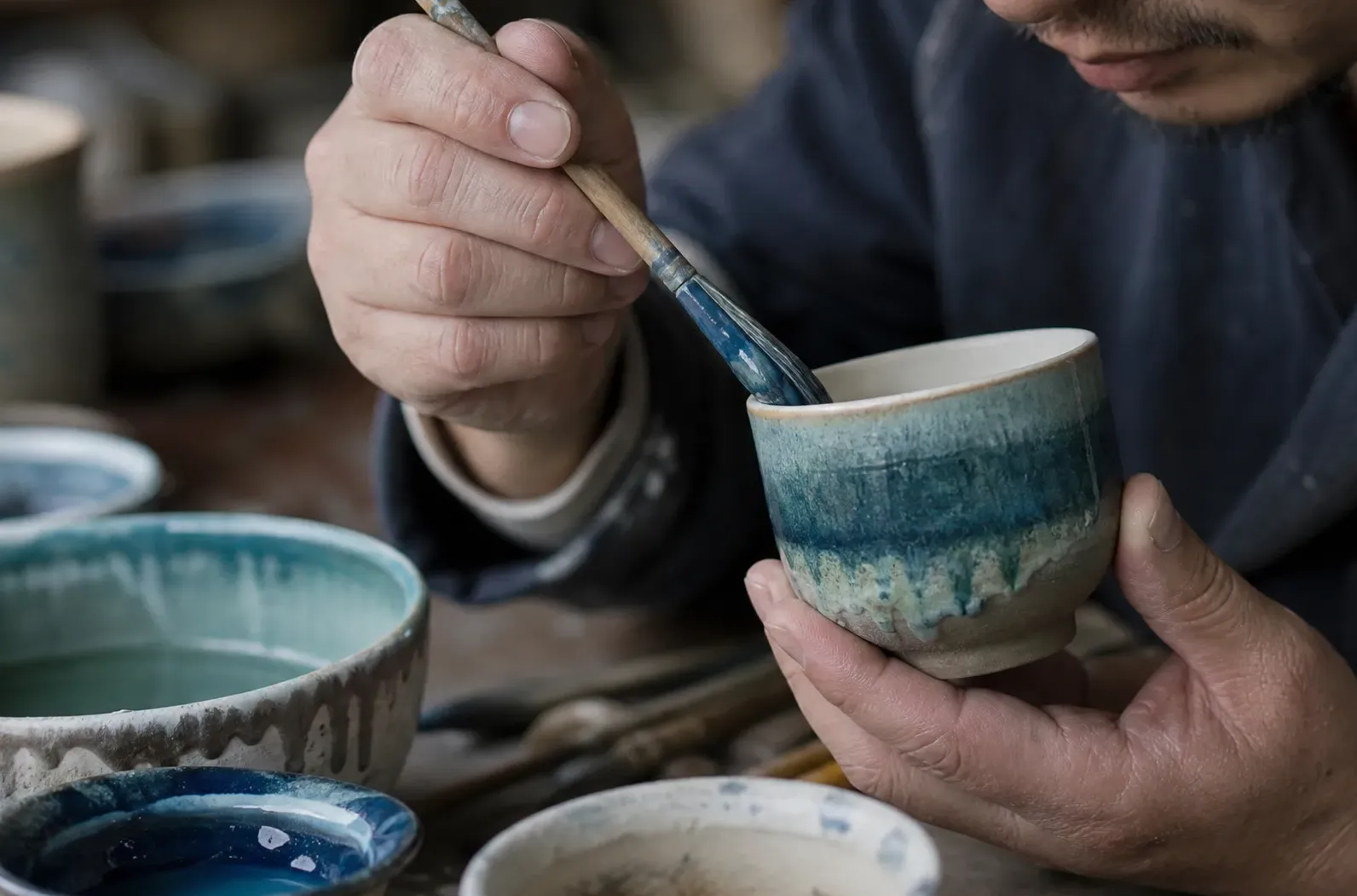
Glaze application — Glaze is hand-brushed in layered coats, building up thickness that will flow and blend in the fire.
High-temperature firing — The kiln rises above 1,330°C over several hours. Atmosphere is actively managed to coax the glaze transformation.
Quality inspection — Pieces are examined for form, glaze integrity, and ring tone. Only those that pass are shipped.